
Bail hearing
If you are arrested and charged with a criminal offence<p><span lang="EN-US">An act that breaks a law that relates to how to behave in society. The harm caused by the act is seen to be against society as a whole, not just a specific person. Sometimes it refers to the specific law that was broken.</span><span> </span></p>, the police may release you and direct you to come to court on a certain date. Or the police may hold you in custody (jail) and then you will have a bail<p><span lang="EN-US">An order made by a judicial justice or a judge releasing an accused person from jail until their trial and requiring them to obey certain conditions (rules) and return to court on a specific date. The legal term for bail is “judicial interim release”.</span><span> </span></p> hearing.
A bail hearing is a court proceeding where a judge or justice decides whether you should be released or held in jail (“remanded<p><span lang="EN-US">“Remanded in custody” means being held in custody until the next court date. “Remand” can also mean to postpone (adjourn) a criminal case to another date. </span><span> </span></p> in custody”) until your next court date. A bail hearing can also be called a “show cause” or “judicial interim release<p><span>Release from custody of a person charged with an offence while they are waiting for their trial or appeal. The release order may require the defendant to obey certain conditions (rules) and return to court on a specific date. The legal term for “bail”. </span></p>” hearing.

How and where bail hearings happen
Most bail hearings in BC take place in Provincial Court, but if you are charged with murder or some other rare offences, your bail hearing will be in the BC Supreme Court.
Bail<p><span lang="EN-US">An order made by a judicial justice or a judge releasing an accused person from jail until their trial and requiring them to obey certain conditions (rules) and return to court on a specific date. The legal term for bail is “judicial interim release”.</span><span> </span></p> hearings in Provincial Court may take place:
- remotely by video conference or by telephone
- in person in a courtroom
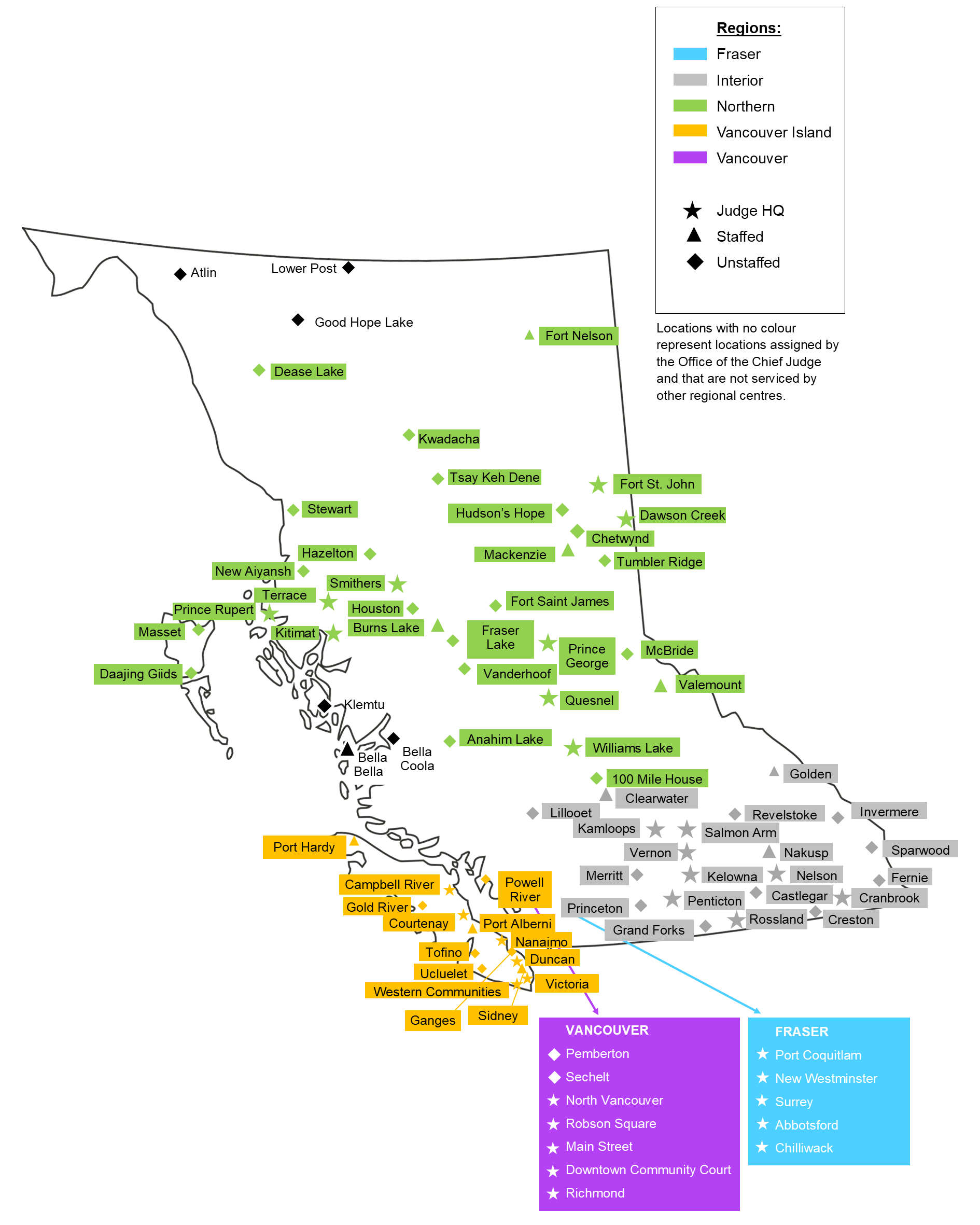
The Court’s CRIM 05 Practice Direction explains how Provincial Court bail hearings happen in different regions of BC. Bail hearings usually take place remotely in the Northern, Interior and Vancouver Island Regions, and either remotely or in person in the Vancouver and Fraser Regions.
CRIM 05 Hearing of Bail Applications
Map showing the five court regions
What happens at a bail hearing
At a bail hearing, Crown counsel<p><span>Counsel is another word for lawyer. Crown counsel are independent lawyers employed by federal or provincial prosecution service to prosecute people charged with offences. Crown counsel do not represent the government, police or victims of crime. Rather, they perform their duties on behalf of the public. Crown counsel may also be referred to as Crown, Crown prosecutors or prosecutors.</span></p> will tell the judge or justice about the charges and any criminal record<p><span lang="EN-US">A list of a person’s convictions for criminal offences and the sentences they received. Criminal records are kept in central computer systems most police agencies across Canada can access.</span><span> </span></p> you may have. You can speak for yourself or have your own lawyer or Legal Aid duty counsel<p><span lang="EN-US">A lawyer paid by Legal Aid BC who can provide free legal advice and representation at a first court appearance and at a bail hearing, but not usually at trial.</span><span> </span></p> speak for you at a bail hearing. If you have a lawyer, they will explain your background, roots in the community (home, family, work or school, etc.), and anything else that might help the judge or justice decide whether you should be kept in jail until your trial.
You may agree to delay your bail hearing and remain in jail so you can hire your own lawyer or get one through Legal Aid.
There are several decisions that could be made at a bail hearing, including to:
- release you on bail without conditions (rules)
- release you on bail with conditions
- keep you in jail
The law that applies to bail hearings
The law that judges and justices must follow in bail hearings includes the Charter of Rights and Freedoms and the Criminal Code<p><span lang="EN-US">Criminal Code of Canada (CCC)</span><span lang="EN-US"> is the federal law that applies across Canada and sets out criminal offences, sentences and how a criminal case proceeds. A judge must follow the law in the </span><span lang="EN-US">Criminal Code</span><span lang="EN-US">.</span><span> </span></p>.
In Canada, there is a presumption that everyone is innocent unless they are proved to be guilty<p><span lang="EN-US">When a person admits (pleads guilty) or is found by the judge or judicial justice (found guilty) to have committed the crimes they are charged with.</span><span> </span></p>. This protects people from being jailed before their trial without valid reasons. The Criminal Code, a law passed by the federal Parliament says that a justice or judge usually must release you without any conditions (rules) unless Crown counsel shows why conditions or jail are needed.
The Supreme Court of Canada explained it this way: releasing accused people is the “cardinal rule,” while detention is the exception. The Supreme Court has pointed out that imprisoning someone before their trial can harm their ability to raise a defense and affect their mental and physical well-being, their families, and their livelihoods – all before their guilt has been proved.
However, there are some offences where you must show why you should be released. Those offences are often called “reverse onus” offences. These are discussed below.
In Canada, accused people have the right not to be denied reasonable bail without just cause. The Criminal Code says that for most offences, keeping you in jail until your trial will only be justified where it is necessary for one of these reasons:
- to ensure you attend court
- for the protection or safety of the public
- to maintain confidence in the administration of justice
It is important to get legal advice, as there is a lot more information you need to know about bail and criminal cases. For example, when deciding whether you are likely to commit offences if you’re released, a judge or justice must order your release unless you pose a substantial risk of offending, or unless the risk cannot be adequately managed with appropriate release conditions.
If you are released, the least strict form of bail is a release without conditions (rules). Most conditions may only be set if Crown counsel shows they are justified and why any less strict form of release would not be adequate. The judge or justice can only set conditions that are necessary, reasonable, clear, and proportional.
Examples of bail conditions could include:
- a curfew
- restrictions on where you can go or who you can contact
- requirements about where you live – for example, requiring you to live at a substance abuse treatment centre
- prohibiting you from having alcohol, drugs or weapons
- prohibiting you from driving
- requiring you to deposit money with the Court
- requiring someone to be your surety<p><span lang="EN-US">Someone who promises to pay money if an accused released on bail does not obey their bail conditions or fails to attend court.</span><span> </span></p> (a person who guarantees your good behaviour and pays money if you do not attend court or if you disobey the bail order)
If you are charged with certain offences, the judge or justice must set a condition prohibiting you from having weapons unless the justice considers that this is not required in the interests of safety.
Depending on the offence you are charged with, there can also be legal requirements for the judge or justice to consider setting other types of conditions. One example is that if you are charged with motor vehicle theft, the judge or justice must consider whether to set a curfew, a condition restricting where you can go, or a condition prohibiting you from having certain tools.
The Criminal Code also says that a judge or justice must pay attention to the circumstances of Aboriginal accused persons and those belonging to vulnerable populations that are over-represented in the criminal justice system.
Other circumstances a judge or justice might consider in making your bail decision include your age, employment, roots in the community, family support, mental condition, membership in a criminal organization, and the circumstances of the victim.
Crown counsel have an important role in the bail hearing.
For most offences, if Crown counsel does not oppose your release on bail or show the need for bail conditions, you must be released without conditions.
Crown counsel might agree to your release without conditions. Your lawyer and Crown counsel might also agree on a plan for your release, often called a “consent release”.
Before the bail hearing, Crown counsel will review your file and the information provided by police. Before recommending a consent release, they often consult with the complainant, the police, and other relevant people.
The Supreme Court of Canada has said that a justice or a judge “should not routinely second-guess” consent release proposals and that consent releases are important to the efficient functioning of the bail system.
The Criminal Code says that if you are charged with certain offences you must be kept in jail unless you can show why that is not justified. You do that by clearly demonstrating that your proposed release plan addresses the risks you pose. Those offences are often called “reverse onus” offences. There is a list of reverse onus offences in the Criminal Code. Some examples are:
- offences involving firearms
- offences against an intimate partner if you have a previous conviction involving violence against an intimate partner
- assault or sexual assault, if the complainant was choked, suffocated, or strangled
- human trafficking
- motor vehicle theft or extortion, where violence was attempted, threatened or used
- murder
For reverse onus offences, even if Crown counsel consents to your release, the judge or justice must state their reasons for your release.
The Criminal Code says that a judge or justice may order that the information given at a bail hearing and the reasons they give for their decision must not be published until the accused person’s trial ends (or they are discharged following a preliminary hearing<p><span lang="EN-US">A hearing before a criminal trial where the judge decides if there is enough evidence to have a trial. Held only in cases involving indictable (serious) offences, when the prosecutor or accused person requests it.</span><span> </span></p>). If the accused person asks for an order like this, the Criminal Code says the judge must make it.
The purpose of this law is to protect the presumption that an accused is innocent until proven guilty, and to ensure they get a fair trial. For example, this prevents members of the jury from being influenced by things said at a bail hearing that are not admissible at trial, if the accused has a jury trial.
If this ban on publication is made, it applies to the evidence and reasons for the bail decision. The outcome of your bail hearing can still be reported.
What happens if you disobey a bail order
If you do not obey a bail order, the consequences could include your bail being revoked, being required to remain in custody until your charges have been dealt with in court, more bail conditions now or in the future if you are charged with another offence, loss of any cash deposit or forfeiture of a promised amount of money, a criminal conviction, and jail. It could also impact your sentence<p><span lang="EN-US">A court order setting out the consequences of being convicted of a crime. Sentences may include fines, community supervision or jail. </span><span> </span></p> if you are found guilty.
This page was printed from:
https://provincialcourt.bc.ca/navigating-court-case/criminal-adult-and-youth/steps-criminal-case/bail-hearing