
Basic information about the Provincial Court of British Columbia and other topics related to reporting on court cases.
Contents
Save section as PDFProvincial Court judges and judicial justices work in almost 90 locations in BC. These include:
Staffed courthouses that are open five days a week with full-time staff
Unstaffed courthouses that are open and staffed part-time
Circuit Courts that are held in various facilities in smaller, remote communities
Indigenous sentencing courts
Specialized integrated, community and treatment courts
These court locations are divided into five regions: Fraser, Interior, North, Vancouver and Vancouver Island.
The BC government, not the Court, is responsible for the province’s courthouses. The government’s Court Services Branch handles the court registry, courtroom staff and requests to access court records.
Court registries and court locations
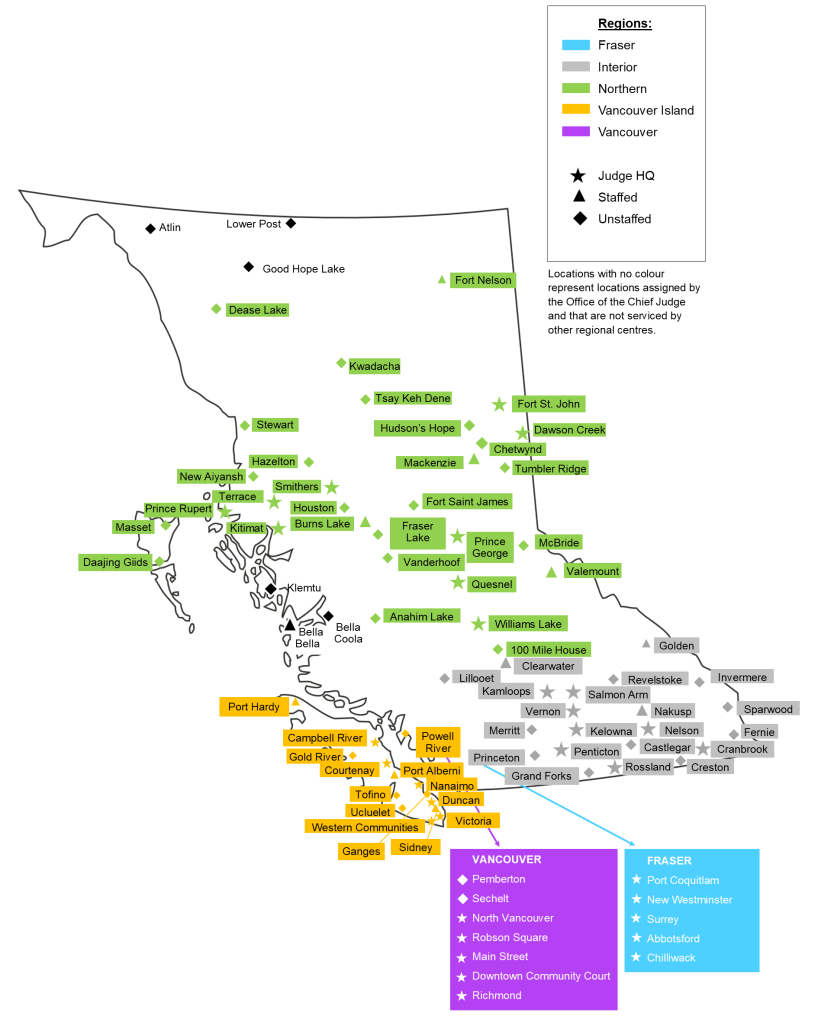
Journalists covering court matters must always be vigilant in case some form of publication ban is in effect.
To find out whether a ban has been issued in a Provincial Court case, ask at the court registry.
If there is any doubt about whether publication is permitted, seek legal advice. Breaching a publication ban may sometimes be an offence under legislation. Other breaches can constitute contempt of court, punishable by the Court. The penalty for breaching a publication ban could be a fine, a conditional discharge or probation order (which might involve community work service) and potentially even jail.
Attending a court case in person or remotely
Trials and most other Provincial Court hearings are open to the public and media, except in rare circumstances where access might be limited, for example, to protect the privacy of children or vulnerable people.
Courtroom courtesy
Judges, lawyers and litigants need to hear each other clearly and concentrate on the case. Please keep that in mind when entering or leaving a courtroom. Members of the public and media can not go beyond the bar unless invited by the judge to do so (the bar is a railing or half wall that separates the public seating area from the area where those involved in a hearing are).
Tools
Most courthouses have public Wi-Fi.
Taking photographs or video inside any Provincial courthouse is generally prohibited, but cameras may be brought into court for safekeeping.
The Use of Electronic Devices in Courtrooms policy explains when and how accredited media may use electronic devices to audio record proceedings for note taking only.
Use of Electronic Devices in Courtrooms which is included as an appendix to the Access Policy
Tips for journalists
Journalists play a crucial role in safeguarding democracy by informing the public how the justice system operates and how the law being applied in our courts affects them. Improved public understanding of court processes and judicial decisions can reduce misinformation that undermines democracy.
Some media have adopted practices that help the public understand the law. The information below can help journalists explain certain common legal concepts to the public.
Explaining the purpose of publication bans
Most publication bans are imposed by Criminal Code provisions that are mandatory and do not give the judge any choice. When bans are discretionary, the law states the factors a judge must consider. When reporting on a ban, explaining its purpose will help people understand the reason for the ban.
Examples
- “The 21-year-old man cannot be named under a court-ordered publication ban put in place to protect the identity of his victim.”
- “The evidence at a preliminary hearing is covered by a publication ban so as not to taint potential jurors with information about the case.”
- “While the contents of a bail hearing are covered by a publication ban to protect an accused’s right to a fair trial, the results of such hearings can be published.”
Explaining legal terms the public may not understand
Examples
- “The case is currently in a voir dire, a hearing generally held to determine admissibility of evidence.”
- “He has requested a preliminary hearing. This is a hearing held to determine if sufficient evidence exists to proceed to trial.”
- “When Crown and defence lawyers make a joint submission on sentence, the judge must follow it unless the proposed sentence would bring the administration of justice into disrepute or would be contrary to the public interest.”
Including sentencing details
Journalists can improve understanding of sentencing by:
Including not only aggravating factors but also mitigating factors about the offender and the offence that were presented in court and considered by the judge
Reporting all aspects of the sentence such as stating if there was a joint submission, identifying the credit required by the Criminal Code for time spent in jail before sentencing, and referring to ancillary orders like licence suspension and Sex Offender Information Registration Act registration
Making it clear when mentioning facts that were not disclosed to the judge
Referring to someone as an offender only if they have been found guilty, before that they are an accused person
Including links to judgments
When a judge’s reasons for decision have been posted online, it is helpful to include a link to the reasons.
Images
Canadian judges don’t use gavels. BC media have led the country in adopting other images for their court reporting, including the stock photos provided by the Provincial Court.
Not in BC!
In BC, judges don’t use gavels
We say lawyer or counsel, not counsellor or attorney
There are no sidebars, everything said in court is on the record
No one “approaches the bench”
The Provincial Court is one of two trial courts in British Columbia. The Supreme Court of British Columbia is the other.
Supreme Court of British Columbia
The Provincial Court deals with cases in five main categories
Adult criminal
Over 95% of criminal cases in BC are heard in Provincial Court. The Criminal Code gives Provincial Court judges the authority to conduct bail hearings, preliminary inquiries, pretrial conferences, trials, and sentencing hearings in criminal matters except for adults charged with murder and a few rare offences such as treason and piracy. These trials are heard in BC Supreme Court.
Family
Provincial Court judges conduct trials and mediation conferences in disputes about guardianship of children, parenting arrangements, and child and spousal support under the Family Law Act and other BC statutes, as well as in child protection matters under the Child, Family and Community Service Act.
People can bring Family Law Act matters to either the Provincial or Supreme Court. However, only the Supreme Court can deal with divorce, adoption, and the division of family assets (except ownership of a companion animal).
Youth criminal
Provincial Court judges deal with young persons aged 12 through 17 who are charged with criminal offences under the Youth Criminal Justice Act.
Small claims
With some exceptions, the BC Provincial Court deals with civil cases involving values from $5001 to $35,000.
Traffic, ticket, bylaw
The Court’s judicial justices hear trials of traffic and bylaw offences, as well as other provincial and municipal offences prosecuted under the Offence Act and the Local Government Act. They also deal with certain federal contravention tickets.
Judicial Officers
The Provincial Court is made up of judges, judicial justices and justice of the peace adjudicators and the staff who support their work. Judges have the authority to hear all of the matters listed above. Judicial justices decide search warrant applications, conduct bail hearings remotely on evenings and weekends and preside in traffic, ticket and bylaw trials and small claims payment hearings. Justice of the peace adjudicators hear one-hour simplified small claims trials in Vancouver and Richmond.
These are the steps that may occur in a criminal case: charges, bail, initial appearance, arraignment, preliminary inquiry, pre-trial conference, trial and sentencing.
What you should know about the steps that may occur in a criminal case
Bail
A judge or judicial justice may only refuse to release an accused person on bail when one of three grounds is established.
Primary ground
Detention is necessary to ensure the accused attends trial.
Secondary ground
There is a substantial likelihood the accused will commit offences endangering the safety of the public.
Tertiary ground
Detention is necessary to maintain public confidence in the administration of justice.
Sometimes, the Crown and defence lawyer agree on a plan for release, often called a consent release. Before making recommendations, the prosecutor reviews the file and the information provided by police, and often consults with the complainant, the police and other relevant parties. The Supreme Court of Canada has said a justice or judge does have discretion but should not routinely second-guess these joint proposals.
Preliminary inquiry
At a preliminary inquiry (also called a preliminary hearing) the judge does not decide guilt or innocence. The judge only decides whether there is sufficient evidence to send the accused person for trial in the Supreme Court of BC. If not, the accused is discharged and the matter is ended. The scope of a preliminary inquiry may be limited to specific issues.
Sentencing
Judges cannot sentence according to their feelings or personal opinions.
BC judges impose hundreds of sentences every day. Each one is based on a judge's full consideration of the relevant legal principles and an assessment of the appropriate range of sentence for a particular offender and offence. However, the law limits their options in many ways. For example:
The Criminal Code, a law passed by elected members of Parliament, sets out sentencing objectives a judge must balance (denunciation, deterrence, protection of the public, rehabilitation, reparation, responsibility, and respect for the law) and principles judges must apply
For example, “an offender should not be deprived of liberty, if less restrictive sanctions may be appropriate in the circumstances”
Judges must balance all of the required factors when determining a sentence
The Criminal Code sets maximum sentences for some offences
Sometimes the prosecutor’s choice of procedure for an offence will limit the judge’s sentencing discretion. For example, when the prosecutor chooses to “proceed summarily” with an auto theft charge, the maximum sentence possible is 18 months in jail, but it is 10 years if the prosecutor chooses to “proceed by indictment”
Sentencing judges must follow the decisions of appeal courts
They must also try to be consistent with other decisions in similar cases
If the range of cases dealing with a particular offence sets a one year jail sentence at the top end of the range, a sentence outside the range set by similar cases may be reversed by an appeal court if appealed
When Crown and defence lawyers make a “joint submission” on the appropriate sentence after a guilty plea, the judge may only reject it if it would “bring the administration of justice into disrepute or is otherwise contrary to the public interest”
Principles you may hear in a criminal case
Presumption of innocence
Under the Canadian Constitution, all accused persons are presumed innocent until they plead or are found guilty by a judge or jury. News reports quoting people who say a crime has been solved or an accused is guilty before they are convicted may be inconsistent with the presumption of innocence.
Burden of proof
In criminal cases, the Crown must present enough admissible evidence to prove beyond a reasonable doubt that the defendant is guilty of the offence charged. An accused person does not have to prove their innocence.
Right to silence
A person accused of an offence cannot be compelled to explain or justify what they have done at any stage of the process. They may refuse to give a statement to police and choose not to call evidence or testify on their own behalf.
Double jeopardy
Individuals may only be punished once for every crime committed. They cannot be retried on the same charge if there is new evidence.
Voir dire
A mini trial conducted within a trial to determine whether evidence is admissible, or whether it should be excluded because of a violation of the Charter of Rights.
Appeals and judicial review
If someone wants to challenge a decision made by the Provincial Court, they can ask a higher court to review it. Depending on the type of case, the higher court could be the Supreme Court of British Columbia or the Court of Appeal for British Columbia. If the Supreme Court reviews the case, its decision could be appealed to the Court of Appeal. In some cases, decisions from the Court of Appeal can be appealed to the Supreme Court of Canada.
If a victim or member of the public is unhappy with a criminal court decision, they cannot appeal it themselves. They must ask the prosecutor (either provincial Crown Counsel or the federal Prosecution Service, depending on the type of crime) to decide whether there is a legal basis to appeal.
Court of Appeal for British Columbia
Supreme Court of British Columbia
Rule of law
Canada is governed by the Rule of Law. The requirement that our courts follow the Rule of Law is a fundamental principle of Canada’s democracy.
The same laws apply to everyone regardless of their occupation, level of wealth, race, colour, sexual orientation, gender or other personal characteristics
All people are treated equally by the same standards
Political influences or popularity polls have no part in a Court of Law, decisions must be made based on the law and evidence
No person is above the law
The rule of law and why it matters (5 minute podcast)
Canada's Rule of Law (Coalition of Canadian Law Societies)
Judicial independence
All Canadians have a constitutional right to have their legal issues decided by fair and impartial judges.
There are three branches of government in Canada:
- The legislative branch passes laws
- The executive branch develops and implements policies
- The judicial branch (the courts) interprets the laws, resolves disputes, and upholds the Constitution including the Canadian Charter of Rights and Freedoms
To uphold the Rule of Law, the judicial branch must be separate from, and operate independently of, all other justice system participants, including the other two branches of government.
Judicial independence means that a court’s judges and judicial justices have the freedom to decide each case on its own merits, without interference or influence of any kind from any source. While judicial decisions rarely result in everyone being happy, our justice system is founded on confidence that decisions, whether popular or not, are fully heard and fairly made. It is crucial that judges be independent and appear to be independent so that people can rely on judicial decisions being made without bias.
To guarantee the right to an independent and impartial judiciary, the law in Canada has constitutional protections or "essential conditions" that ensure judicial independence. These are security of tenure, financial security and administrative independence.
Judicial Council Annual Reports
Judges and justices in British Columbia must apply three types of law:
Canada’s constitution set out in the Constitution Act, 1867 and the Canadian Charter of Rights and Freedoms
Legislation including acts and regulations passed by the federal Parliament or the provincial Legislature and municipal bylaws
Common law: the vast body of judicial decisions that have shaped Canadian law. This can include decisions of British courts which is where our common law comes from, but the majority of decisions referred to today are from Canadian courts
The BC Provincial Court has established operational performance standards representing the goals and performance targets it strives to meet with the judicial resources available.
The Court is committed to transparency and publishes annual reports which include details on caseload statistics, how the Court is meeting performance targets, and other data such as how many times people appeared remotely or how often people represented themselves in court. Where standards are not met, the Office of the Chief Judge examines underlying causes, monitors trends and takes steps including reallocating available resources where possible.
The Court also reports up-to-date figures on wait times in semi-annual time to trial reports and in its annual reports.
Judges and judicial justices in British Columbia are appointed based on merit. The Lieutenant Governor in Council appoints Provincial Court judges and judicial justices on the recommendation of the Judicial Council of BC following a merit-based process. BC Provincial Court judges must have practised law in Canada for at least ten years before being appointed. Judicial justices must have practised law in Canada for at least five years.
The Judicial Council of BC consists of nine members, including members of the public, lawyers and judges, with responsibility for improving the quality of services provided by the Provincial Court’s judges and judicial justices. They also interview applicants and recommend those who are qualified.
The Provincial Court Act sets out the process the Chief Judge or their delegate must follow when a complaint about judicial conduct is received. There are three possible stages: examination, investigation and inquiry. The Office of the Chief Judge examines complaints. If the matter proceeds to inquiry, Judicial Council can conduct the inquiry.
Judges and judicial justices engage in ongoing judicial education throughout their careers to keep up to date on the law and remain sensitive to the social and cultural context of the communities they work in.
The Court posts monthly Judicial Complement Reports showing the current number of judges. The Court’s Annual Reports and the BC Judicial Council Annual Reports provide information on the demographics of applicants for judicial appointment and those appointed.
Judicial Council Annual Reports