
Shedding light on a little-known story
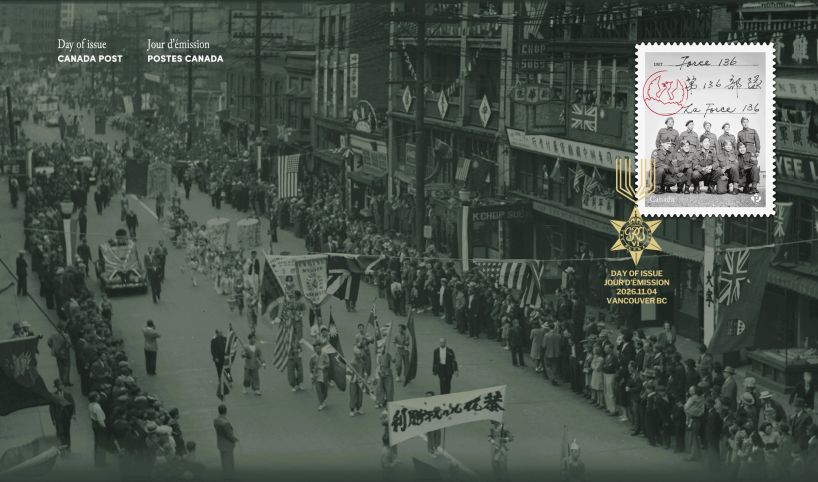
Retired judge Brent Hoy has a special reason to celebrate the unveiling of Canada’s 2026 Remembrance Day stamp at the Chinese Canadian Museum in Vancouver on November 3. The stamp honors Chinese Canadians who served in Force 136, a British Special Operations Executive branch responsible for covert missions in Southeast Asia during WWII. It shows ten soldiers. One of them is his father.
Charles Hoy was born on June 22, 1918, in Vancouver, but that did not make him a Canadian citizen. Canada’s 1923 Chinese Immigration Act required people of Chinese origin residing in Canada to report to a local registrar and register by June 30, 1924. If they didn’t, they could be fined $500, imprisoned, or deported. Charles Hoy was registered on June 26, 1924. He was 6 years old. The photo identification card he was issued, called the C.I. 45, specified that it did not confer any legal status in Canada.
Speaking at the unveiling ceremony on November 3, the retired judge said, “My father was born into an era of exclusion, marginalization, containment and dehumanization. He was prohibited from being a Canadian and relegated to a society of rejection and menial employment. He could not vote or become a lawyer or a doctor. He was considered an undesirable person with no rights or meaningful opportunity except servitude. Society’s attitudes were entrenched by federal legislation and innumerable provincial and local laws.”
Yet the hostility, repression and blatant racism they lived with did not deter Charles Hoy and about 150 other young Chinese Canadians from volunteering to join Force 136, despite warnings they would be killed as spies if captured.
Modelled on the secret agents working in Nazi-occupied Europe, Force 136 was formed to support and train resistance movements in Japanese-occupied Asia. Earlier in the war, most Chinese Canadians volunteering in British Columbia had been rejected but in Force 136 their appearance and ability to speak Cantonese and English were advantages. The first group of recruits was trained at Commando Bay on Lake Okanagan and in Australia. Others, including Charles Hoy, were trained in India.
The Canadian Encyclopedia reports that the recruits’ biggest training challenge was to silently swim long distances carrying a 50 pound pack. Most didn’t know how to swim because Chinese Canadians weren’t then allowed in British Columbia’s public pools.
On missions in Southeast Asia with code names like Operation Galvanic, Operation Humor, Operation Snooper and Operation Sergeant, members of the Force disabled telephone lines and blew up railway tracks while battling jungle conditions including heat, humidity, monsoons, snakes, insects, dysentery, and malaria as well as wounds and broken bones. At the end of the war, some remained to help maintain order and liberate prisoner-of-war camps.
Some of the veterans suffered continuing health problems due to the conditions they encountered in the field. And no transport home was provided for the men stationed in Australia at the end of the war. Most had to find work as deckhands on cargo ships to pay for their passage home.
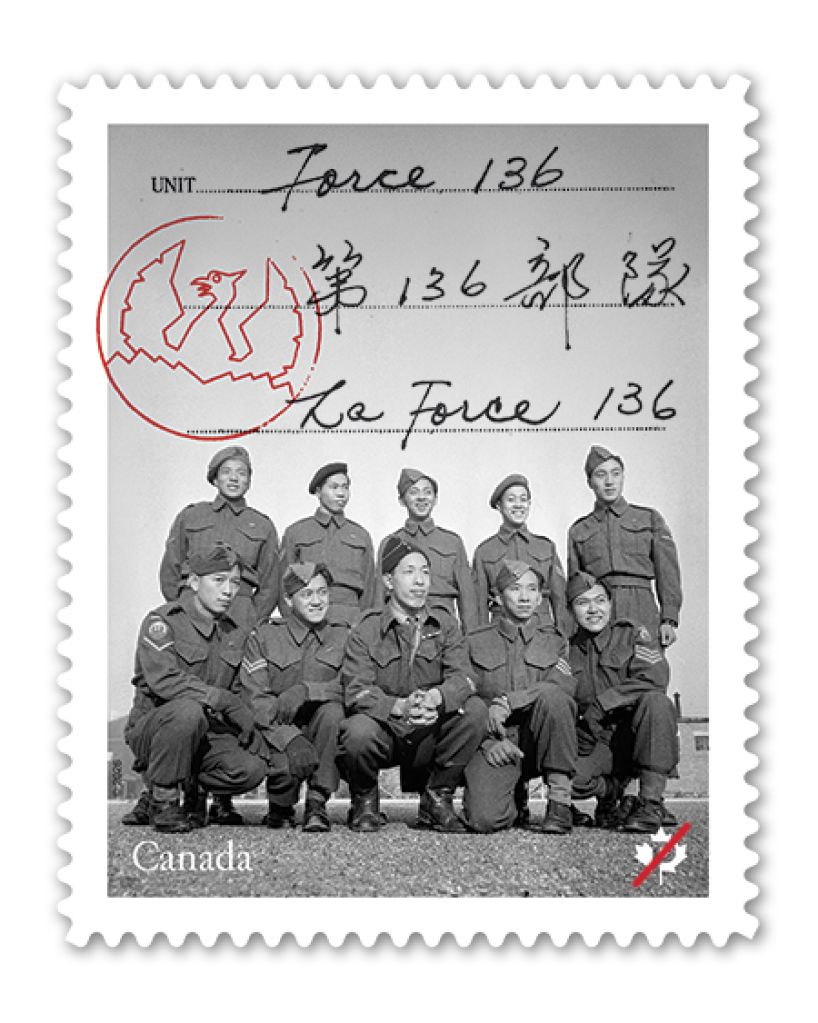
The veterans shown in the 2026 Remembrance Day stamp are, from left to right, front row: Charles Lum, Robert W.J. Lee, Donald Sung, Charlie Hoy, Jack Matthew Chui and back row: Dick Yip, James Young Ming Wong, Gordon Wong, Horace Lee, Robert Yeasting.
Retired judge Hoy observed, “If you look closely at the men on this stamp it is obvious they wear their uniforms with confidence and pride. You can see the shoulder flash of the rising phoenix on their uniform. It’s an emblem of the Allied Forces symbolizing liberation and re-birth. Above all else the men stand together in solidarity, as a group distinguished by their race and their Canadian uniforms.”
He recalled, “My father joined Force 136 when he was 26 and was sworn to secrecy about his service. While he never really shared much about his experiences I understand he was assigned as a communications officer. He recalled his trips overseas in troop carriers. Jungle tactics were part of his training in Poona, India. And he took delight in teaching me morse code. My father passed away on December 2, 2002, at the age of 84. He was a modest but proud man. I can visualize his broad and knowing but close-lipped smile of approval of this commemoration.”
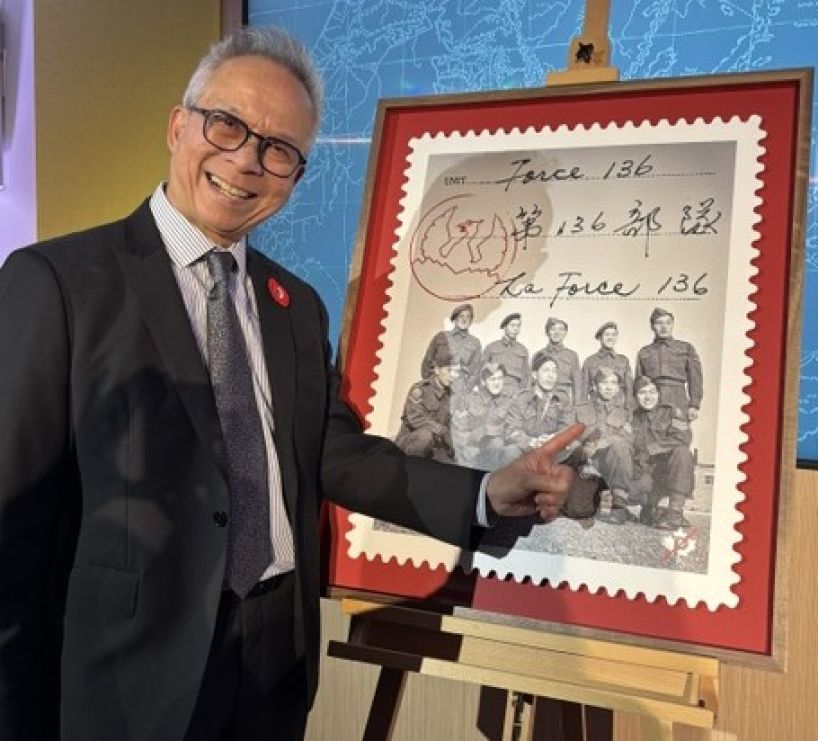
Charles Hoy and his fellow recruits voluntarily joined Force 136 for a country that had rejected them. They were prepared to sacrifice their lives. “This selfless sense of duty shines a bright light on the fact that we, in the generations after them, are the offspring of our ancestor’s courage, persistence, commitment and sacrifice and the breaking of institutional and systemic prejudice” Judge Hoy said. “When Chinese Canadians obtained citizenship in 1947 it was earned, not given, and we shouldn’t forget that. They gave us the chance to fulfill everything it means to be Canadian.”
He concluded, “This Remembrance Day stamp is a symbol for all Canadians to remember and cherish the unique contributions of Force 136. It commemorates and acknowledges with gratitude their service and sacrifices during the second World War. It will be in circulation for many years. There is a sense of immortality to it as it commemorates events from an important page of Canadiana, the military service they voluntarily gave to Canada.”
Chinese Canadians of Force 136 (Canadian Encyclopedia)
Stamp photos: Canada Post
This page was printed from:
https://provincialcourt.bc.ca/news-notices-policies-and-practice-directions/enews/04-11-2026